
Mindfulness Activities for Couples
Mindfulness activities for couples offer a powerful and practical way to reconnect in a world filled with distraction, stress, and emotional disconnection. Practicing mindfulness exercises together helps partners slow down, improve communication, and rebuild the emotional safety that healthy relationships depend on. These mindfulness practices for relationships support deeper emotional connection, reduce conflict, and help couples stay present with each other in everyday moments.
It’s important to recognize that mindfulness doesn’t always feel calm or easy at first. Because modern life often encourages constant distraction, many people carry unprocessed emotions, bodily tension, and unresolved relational patterns without realizing it. When couples intentionally pause and bring awareness to the present moment, these experiences can begin to surface — not as a setback, but as the beginning of emotional release, regulation, and integration.
Intentional mindfulness exercises for couples gently create space for this awareness. As partners learn to observe their thoughts, emotions, and physical sensations without judgment, they also become more attuned to each other’s inner experiences. This process naturally deepens intimacy, reduces reactive conflict, and strengthens the ability to remain connected in both joyful and challenging situations.
The Importance of Mindfulness in Relationships
Mindfulness is the practice of bringing full awareness to the present moment without judgment, creating the foundation for emotional safety and connection (Kabat-Zinn, 1994). In relationships, it means noticing our own inner experience and our partner’s emotional cues in real time. Couple mindfulness activities help both partners recognize activations, regulate emotions, and communicate from awareness rather than reactivity. As Dr. John Gottman’s research on emotional attunement demonstrates, the ability to remain present during conflict strongly predicts long-term relational stability. Over time, mindfulness exercises for couples strengthen empathy, co-regulation, and trust; the very qualities that attachment theorists John Bowlby and Mary Ainsworth identified as the foundation of secure love and encapsulated in the concept of maternal sensitivity, the caregiver’s capacity to perceive, interpret, and respond appropriately to another’s emotional state.
Benefits of Mindfulness in Relationships
Increase Openness
Mindfulness helps partners express emotions with authenticity and curiosity. By listening with empathy and withholding judgment, couples create a safe environment where vulnerability feels natural and connection deepens. This openness mirrors what attachment theorist Dr. Mary Ainsworth described as the secure base: a relational climate in which both individuals feel free to explore, express, and return for comfort with certainty. Over time, this kind of mindful presence strengthens emotional transparency and trust. Partners learn to share their inner world while remaining receptive to each other’s, cultivating the mutual safety that John Bowlby identified as the essence of secure attachment.
Improve Emotional Regulation
Neuroscientist Richard J. Davidson found that mindfulness practice decreases reactivity in the amygdala, the brain’s fear center, while increasing activation in the prefrontal cortex and insula, areas linked to empathy, regulation, and self-awareness (Davidson & McEwen, 2012). In relationships, this means that mindfulness literally reshapes the brain toward greater emotional steadiness and compassion. When partners can pause, notice physiological activation, and breathe before reacting, they create a neurobiological space for safety and understanding. Over time, this practice strengthens what Daniel Siegel calls “integration”: the linking of body, mind, and emotion, which allows couples to transform conflict into moments of connection and repair.
Increase Compassion and Empathy
Research by Dr. Barbara Fredrickson demonstrates that loving-kindness meditation expands positive emotions, strengthens vagal tone, and deepens social connectedness. This is the physiological foundation of empathy and trust (Fredrickson, 2013). When couples engage in mindfulness activities for couples, they begin to cultivate what Fredrickson calls positivity resonance, a shared state of warmth, synchrony, and mutual care. In this space, compassion becomes less about problem-solving and more about presence. This aligns with Dr. Dan Siegel’s concept of mindsight, the capacity to sense and attune to another’s inner world with curiosity and openness. Through such practices, partners build neural pathways for empathy, safety, and secure connection.
Support Difficult Conversations
Dr. John Gottman’s decades of research on relationship repair highlight that mindfulness supports the calm physiological states necessary for constructive dialogue. When partners practice couples mindfulness exercises, they learn to notice rising tension before it overwhelms the relationship. This awareness helps regulate heart rate, breath, and tone of voice, key indicators of what Gottman calls the body’s diffuse physiological arousal, the state in which productive communication becomes impossible. By grounding attention and slowing reactivity, mindfulness allows couples to stay emotionally connected even when discussing difficult topics, transforming moments of potential rupture into opportunities for vulnerability, empathy, and repair.
Increase Self-Awareness and Awareness of Others
Mindfulness enhances both introspection and empathy, the twin pillars of secure attachment (Siegel, 2007). Through self-awareness, partners begin to recognize their own emotional patterns, reducing projection, defensiveness, and blame. Simultaneously, mindfulness heightens sensitivity to the other’s emotional state, fostering genuine attunement. Dr. Dan Siegel describes this integration of self and other as the foundation of mindsight: the ability to perceive one’s own mind while resonating with another’s. In relationships, this creates what attachment theorists call a secure functioning system: two minds capable of co-regulation, authenticity, and repair. Over time, mindfulness transforms relationships into conscious, collaborative partnerships grounded in mutual awareness and care.
Mindfulness Exercises for Couples
Mindful Reflection
Set aside dedicated time each week to reflect together on your relationship—free from distractions, devices, or multitasking. Approach the conversation with openness and curiosity rather than problem-solving. You might ask questions such as, “What helped us feel close this week?”, “What moment felt challenging for us?”, or “What did I appreciate about you that I didn’t mention?” The purpose is to understand each other’s inner worlds and to bridge them collaboratively.
This practice encourages emotional literacy: the ability to name, explore, and communicate feelings with honesty and care. When partners share in this way, they begin to model what John Bowlby (1988) described as secure functioning: mutual responsiveness and trust in one another’s availability. By making reflection a consistent ritual, couples cultivate what Dr. John Gottman calls a “culture of appreciation,” transforming everyday moments into opportunities for connection and repair.
Mindful reflection also aligns with Dan Siegel’s concept of integration by linking insight with empathy so that both partners can hold their individuality within shared understanding. Over time, this simple practice rewires patterns of reactivity into responsiveness, helping couples feel more seen, valued, and emotionally safe together.
Loving-Kindness Meditation for Couples
Sit comfortably together, close your eyes, and bring your partner to mind. Silently repeat phrases such as, “May you feel safe. May you feel loved. May you be at peace.” Then, expand this circle of goodwill to include yourself, your family, and eventually all beings. Known as metta in Buddhist tradition, this practice trains the heart to stay open, even when conflict or pain arise.
Dr. Barbara Fredrickson’s research on positivity resonance shows that loving-kindness meditation enhances emotional resilience, strengthens vagal tone, and increases feelings of connection and empathy. For couples, it cultivates a felt sense of warmth and safety that supports mutual regulation, the foundation of secure attachment. Shinzen Young describes this as developing “mutual resonance,” where two nervous systems begin to harmonize through shared presence and compassion.
When practiced regularly, loving-kindness helps transform irritations and disappointments into opportunities for care. Over time, it replaces judgment with understanding and indifference with affection. Even a few minutes a day can shift the emotional climate of a relationship, allowing love to feel both tender and grounded—a refuge rather than a battlefield.
Practice Gratitude Together
Each day, take a few moments to name one thing you genuinely appreciate about your partner. It could be something small: how they made coffee, offered a kind word, or remembered to check in after a long day. Speak your gratitude out loud, making sure it’s specific and heartfelt.
According to Dr. Robert Emmons, one of the leading researchers on gratitude, couples who regularly express appreciation experience higher relationship satisfaction, more optimism, and lower stress. Gratitude interrupts the brain’s negativity bias, its tendency to fixate on threats or unmet needs and redirects attention toward what is working and nourishing.
In attachment terms, this consistent acknowledgment reinforces secure functioning: both partners feel valued and emotionally safe. Over time, the practice builds a reservoir of goodwill that acts as a buffer during moments of tension or misunderstanding. Gratitude also activates oxytocin and dopamine, the neurochemicals linked to bonding and pleasure.
As John Gottman notes, thriving relationships are not defined by the absence of conflict but by the presence of appreciation. By consciously cultivating gratitude, couples strengthen the emotional foundation on which trust, resilience, and intimacy naturally grow.
Journaling
Mindful journaling offers a bridge between private reflection and shared understanding. Each partner sets aside 10–15 minutes to write freely about their inner experience—emotions, hopes, or challenges in the relationship. The aim is not literary perfection but honesty. When finished, share whatever feels comfortable, listening without interrupting or defending.
Writing slows down thought and brings awareness to the deeper layers beneath surface emotion. As Dr. Dan Siegel describes, this reflective process promotes integration—linking emotion with awareness to create a coherent internal narrative. Journaling can reveal patterns of reactivity, unmet needs, or tender longings that often go unspoken.
From an attachment perspective, this practice mirrors the earned secure process: moving from implicit, unexamined reactions toward conscious, compassionate self-understanding. Over time, journaling helps couples approach each other with greater empathy, curiosity, and humility.
By revisiting entries periodically, partners can see how their communication, trust, and self-awareness evolve. This makes journaling not just an introspective tool, but a living document of growth—evidence that love deepens not through perfection, but through mindful attention and repair.
Couple Mindfulness Meditation
Set aside 10–20 minutes to meditate together. Sit facing each other or side by side, focusing on your breath or simply sensing the shared space between you. Notice the subtle shifts—your partner’s breathing, body language, or emotional tone—without needing to control or synchronize.
Dr. Richard Davidson’s neuroscience research shows that when people meditate together, their brain waves and heart rhythms often begin to align, reflecting what psychologists call interpersonal resonance. This physiological coherence strengthens co-regulation and empathy—the same qualities found in securely attached relationships.
In this practice, silence becomes a shared language. Partners experience what Dr. Sue Johnson calls emotional responsiveness: the felt knowing that “you are here with me.” Rather than merging, the couple learns to rest in presence together—two distinct selves joined in awareness.
Practiced consistently, couple meditation enhances emotional stability, patience, and mutual care. It becomes a refuge of quiet connection, reminding both partners that even when words fail, mindful presence can communicate safety, love, and belonging.
Mindful Touch
Physical touch is one of the most direct ways to restore connection. Sit together and hold hands, hug, or gently place a hand over your partner’s heart. Bring full attention to the sensations—the temperature of their skin, the rhythm of their breath, the emotions that arise.
According to Dr. Kerstin Uvnäs-Moberg’s research, affectionate touch stimulates oxytocin release, calming the stress response and fostering trust. When paired with mindfulness, touch becomes more than physical—it becomes a dialogue of presence. Notice any resistance, longing, or tenderness without judgment.
In attachment theory, safe touch embodies what John Bowlby called the secure base: the reassurance that closeness does not threaten individuality but supports it. This practice helps couples regulate each other’s nervous systems through warmth and attunement, gradually rebuilding safety where it may have been lost.
Even a few mindful moments of contact can shift the body from vigilance to ease. Over time, this ritual teaches that love can be felt directly through awareness—no words, no effort, just the quiet knowing of connection and care.
A Path Toward Shared Presence
Mindfulness in relationships is all about ongoing connection and engagement. Each of these couple mindfulness activities, reflection, meditation, gratitude, journaling, and mindful touch, helps partners move from automatic reaction to conscious connection. As Dr. Dan P. Brown and Dr. David S. Elliott describe in Attachment Disturbances in Adults, healing and security develop through repeated experiences of attunement and repair. Practicing mindfulness exercises for couples transforms those moments into habits of the heart and mind. Over time, mindfulness becomes more than a personal discipline; it becomes a shared spiritual practice of love, where all encompassing awareness itself becomes the bond.
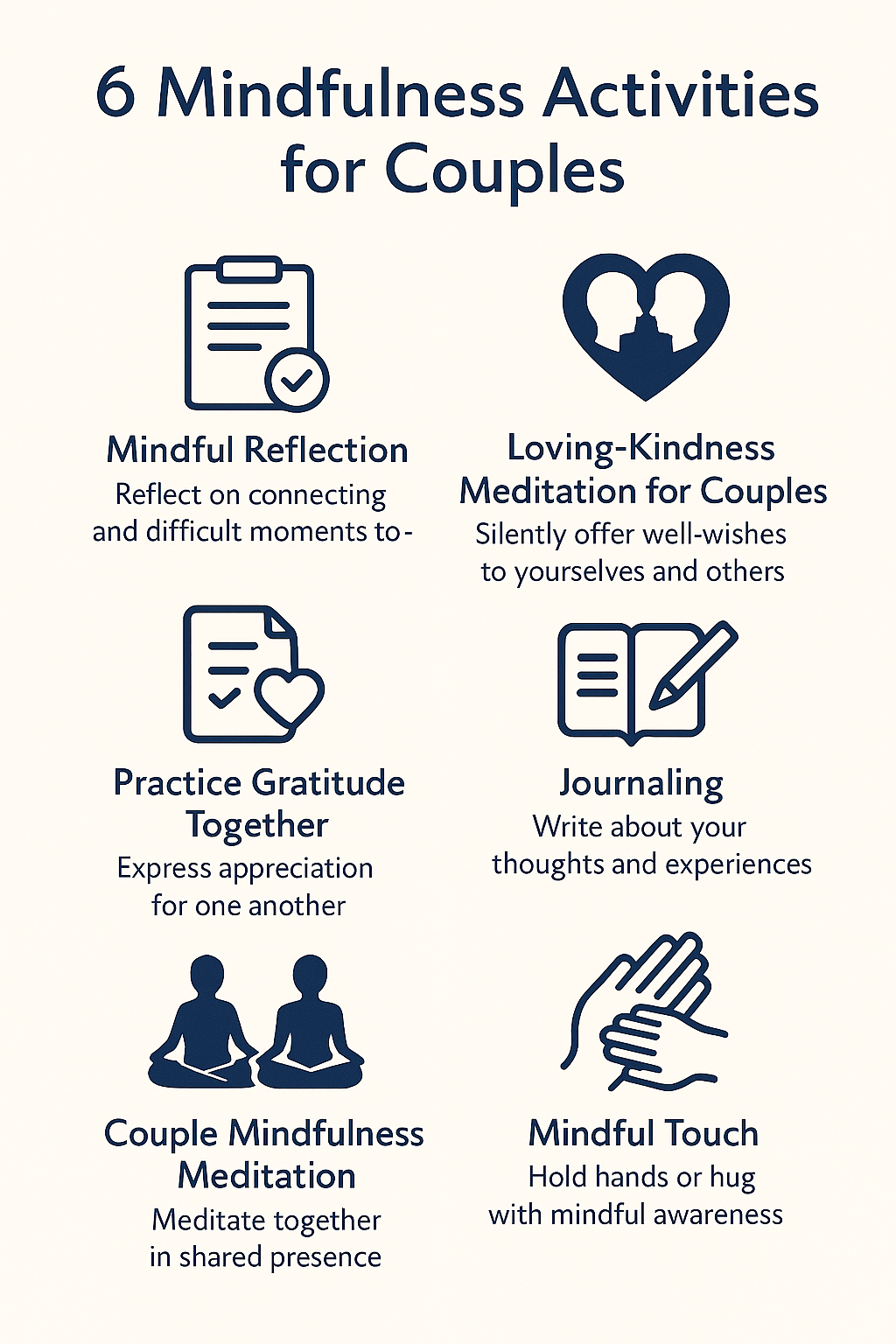
Six simple mindfulness practices couples can use to deepen connection: mindful reflection, loving-kindness meditation, gratitude, journaling, shared mindfulness meditation, and mindful touch. These practices help partners slow down, become more present with one another, and strengthen their emotional bond.
Frequently Asked Questions
What are mindfulness activities for couples?
Mindfulness activities for couples are simple practices that help partners stay present with each other. These exercises increase awareness of thoughts, emotions, and physical sensations, improving emotional connection, communication, and relationship quality.
How does mindfulness improve relationships?
Mindfulness improves relationships by helping partners become aware of their reactions and communication patterns. This leads to calmer conflict resolution, deeper intimacy, and greater emotional safety.
What mindfulness exercises can couples do at home?
Couples can practice mindful breathing, eye contact, mindful listening, body scan exercises, and distraction-free walks. These activities help partners slow down and reconnect.
What are the benefits of mindfulness in relationships?
Mindfulness in relationships improves communication, reduces conflict, strengthens emotional intimacy, and helps partners stay connected during challenging moments.
How can couples practice mindful communication?
Couples practice mindful communication by listening without interrupting, speaking with awareness, and focusing on understanding rather than reacting.
References & Influential Sources
Bowlby, J. (1988). A Secure Base: Parent–Child Attachment and Healthy Human Development.
Ainsworth, M. D. S. (1978). Patterns of Attachment: A Psychological Study of the Strange Situation.
Brown, D. P., & Elliott, D. S. (2016). Attachment Disturbances in Adults: Treatment for Comprehensive Repair.
Davidson, R. J., & McEwen, B. S. (2012). “Social Influences on Neuroplasticity.” Nature Neuroscience.
Emmons, R. A., & McCullough, M. E. (2003). “Counting Blessings Versus Burdens.” Journal of Personality and Social Psychology.
Fredrickson, B. L. (2013). Love 2.0: Creating Happiness and Health in Moments of Connection.
Gottman, J. M., & Silver, N. (2015). The Seven Principles for Making Marriage Work.
Kabat-Zinn, J. (1994). Wherever You Go, There You Are: Mindfulness Meditation in Everyday Life.
Siegel, D. J. (2007). The Mindful Brain: Reflection and Attunement in the Cultivation of Well-Being.
Shinzen Young (2016). The Science of Enlightenment.
Uvnäs-Moberg, K. (1998). “Oxytocin May Mediate the Benefits of Positive Social Interaction.” Psychoneuroendocrinology.
