
Healing childhood wounds is crucial for adults who carry unresolved emotional injuries from their early years. Nearly 60% of adults struggle with low self-worth, emotional difficulties, and relationship challenges caused by childhood wounds, often without realizing the connection. Childhood wounds happen when a child grows up without consistent safety, attunement, or emotional support, and they continue to influence adult behavior, emotions, and relationships.
People often ask: How can I heal childhood wounds? What is the best way to care for my inner child? Can attachment-focused coaching help with childhood trauma? Healing is possible through compassion, reparenting practices, and secure attachment techniques, which help the inner child receive the care, understanding, and presence they missed. Healing is not about changing the past—it is about reshaping emotional patterns, building self-compassion, and creating healthier adult relationships.
Types of Childhood Wounds
The following are the most common types of childhood wounds, each with unique effects on adulthood. Understanding these patterns is the first step in learning to heal childhood wounds and restore emotional safety.
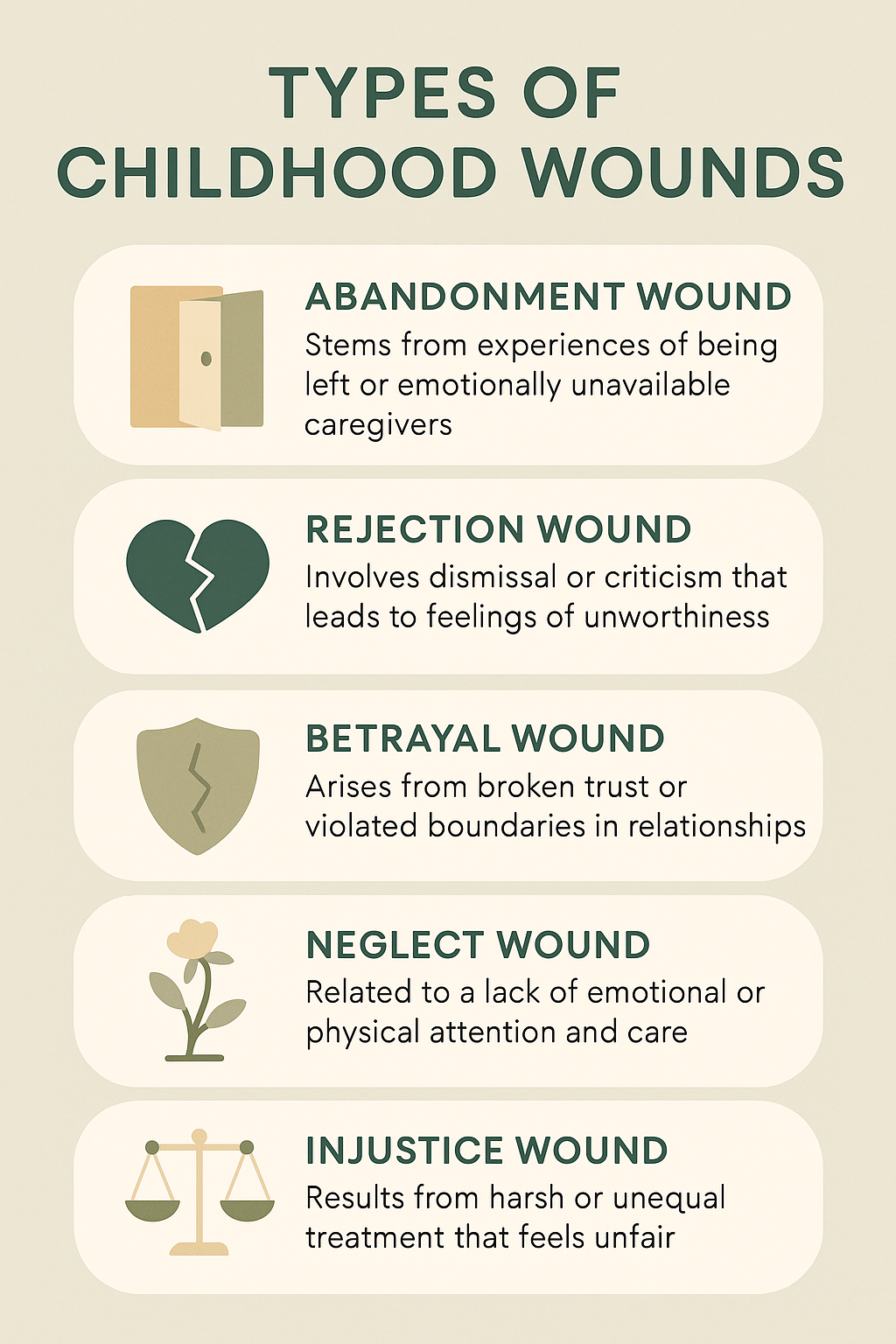
The five main types of childhood emotional wounds: abandonment, rejection, betrayal, neglect, and injustice. Each wound highlights how early relational experiences can shape emotional patterns and attachment in adulthood.
Abandonment Wounds
Abandonment wounds form when a child experiences emotional or physical absence from caregivers. This may involve inconsistency, divorce, illness, addiction, or a parent who is physically present but emotionally unreachable. Because the child cannot rely on steady connection, the nervous system learns to stay alert for signs of loss. The child internalizes the belief that people leave, that connection is unpredictable, and that they must work hard to keep relationships from falling apart.
Impact in adulthood:
Adults with abandonment wounds often experience anxious attachment, fear of disconnection, and hypersensitivity to relational shifts. Delayed responses, changes in tone, or emotional distance can trigger panic or protest behaviors. Many cling to unhealthy relationships, overfunction to maintain closeness, or feel overwhelmed by loneliness. Healing involves learning that presence can be consistent, developing trust in safe connections, and discovering that love does not require self-abandonment.
Rejection Wounds
Rejection wounds develop when a child’s emotions, identity, or needs are criticized, dismissed, or shamed. This may occur through overt messages, such as “Stop crying,” or subtle cues that the child is “too much” or “not enough.” The child begins to believe their authentic self is unacceptable. As a result, they learn to suppress feelings, hide vulnerability, or mold themselves to gain approval.
Impact in adulthood:
Adults with rejection wounds often struggle with low self-worth, sensitivity to criticism, and fear of emotional exposure. They may become people-pleasers, perfectionists, or high achievers who work tirelessly to avoid rejection. Intimacy can feel threatening because being truly seen raises the risk of being judged or dismissed again. Healing requires developing unconditional self-acceptance, practicing authentic expression, and forming relationships where emotional truth is welcomed rather than criticized.
Betrayal Wounds
Betrayal wounds arise when a trusted caregiver violates emotional or relational safety. This includes broken promises, lies, infidelity between parents, emotional triangulation, or parentification. The child learns that trust is fragile and that people who claim to care may still cause harm. These early ruptures disrupt the child’s ability to feel safe in closeness and can create deep confusion about loyalty and boundaries.
Impact in adulthood:
Adults with betrayal wounds often carry heightened vigilance in relationships. They may anticipate deception, struggle with commitment, or test partners to assess trustworthiness. Some avoid emotional intimacy entirely, while others enter relationships but remain guarded. These adults may find themselves repeatedly drawn to unavailable or unpredictable partners. Healing focuses on rebuilding inner safety, strengthening boundaries, and learning to differentiate past betrayal from present relational reality.
Neglect Wounds
Neglect wounds develop when caregivers fail to meet a child’s emotional or physical needs. This may involve lack of affection, limited engagement, or emotional flatness. Even when parents are not intentionally harmful, a child who grows up without attunement learns that their needs are invisible or unimportant. Without consistent emotional mirroring, the child may struggle to understand or regulate internal states.
Impact in adulthood:
Adults with neglect wounds often experience difficulty identifying needs, expressing emotions, or receiving support. Many adopt extreme independence, believing they must handle everything alone. Vulnerability may feel unsafe or shameful. These adults may also gravitate toward avoidant attachment because closeness feels unfamiliar or overwhelming. Healing involves reconnecting with emotional needs, practicing self-compassion, and slowly allowing trustworthy others to provide care.
Injustice Wounds
Injustice wounds form in environments marked by harshness, rigidity, favoritism, criticism, or unpredictable punishment. The child learns that the world is unfair and that safety depends on high performance, compliance, or emotional suppression. These children often adapt by becoming hyper-responsible or by developing a strong internal critic to avoid punishment or shame.
Impact in adulthood:
Adults with injustice wounds frequently struggle with perfectionism, anger, or chronic self-judgment. They may feel compelled to control circumstances to avoid being treated unfairly again. Many have difficulty relaxing, delegating, or trusting others, especially in situations involving power or authority. These wounds can also limit emotional flexibility, making self-compassion difficult. Healing involves softening rigid defenses, challenging perfectionistic beliefs, and cultivating environments that support gentleness and fairness.
Childhood Wounds and Attachment
Childhood wounds shape attachment patterns more powerfully than any other early influence. When children experience consistent emotional safety, attunement, and repair, the nervous system organizes around connection, creating a secure attachment style. However, when childhood trauma wounds such as abandonment, rejection, betrayal, or neglect occur, the nervous system shifts into protection mode instead. This shift influences how a child learns to seek closeness, handle emotions, and expect others to respond.
Abandonment and rejection wounds often lead to anxious attachment, where the adult becomes hyper-aware of relational shifts and fears disconnection.
Neglect and emotional distance frequently contribute to avoidant attachment, where vulnerability feels unsafe and independence becomes the primary coping strategy.
Chaotic, frightening, or inconsistent caregiving is strongly associated with fearful-avoidant attachment, marked by a push-pull dynamic of longing and fear.
Understanding the connection between childhood wounds and attachment styles is essential for healing. Although these patterns form early, attachment is not fixed. Through inner child work, reparenting practices, somatic healing, and supportive relationships, adults can gradually reorganize toward secure attachment. This process restores emotional safety from the inside out and allows for deeper intimacy, healthier boundaries, and greater self-trust.
How to Heal Childhood Wounds
Recognize the Wound
Healing begins with clearly identifying the childhood wound and understanding how it shows up in your adult life. Notice the patterns, triggers, and emotional reactions connected to old experiences. Recognition brings these unconscious wounds into conscious awareness, allowing you to separate past pain from present reality. This clarity creates the foundation for change and frees you from repeating protective patterns that no longer serve you.
Validate Your Feelings
Validation is essential for healing childhood wounds. Instead of minimizing or judging your emotional reactions, acknowledge that they make sense within the context of your early experiences. When you validate your feelings, you create internal safety and reduce shame. This compassionate stance helps you regulate more effectively and begins to repair the emotional dismissals or misattunement you may have experienced growing up.
Understand Your Inner Child
Healing deepens when you connect with the younger parts of yourself who still hold unmet needs, fears, or beliefs formed during childhood. Inner child awareness helps you recognize why certain situations feel disproportionately painful or activating. By turning toward these younger parts with curiosity and compassion, you begin to meet needs that were never acknowledged, allowing emotional burdens to soften and integrate.
Reparent Yourself
Reparenting involves providing yourself with the nurturing, protection, and emotional responsiveness that were missing earlier in life. Through warm self-talk, secure internal boundaries, and consistent care, you begin repairing childhood wounds from the inside out. This process teaches the nervous system new patterns of safety and offers younger parts of you the stable, reliable support they never received.
Build New Beliefs
Childhood wounds often leave behind painful core beliefs such as “I’m unlovable,” “I’m alone,” or “I have to handle everything myself.” Healing requires gently replacing these narratives with more accurate, compassionate truths. As you practice new beliefs through repetition and relational experiences, your emotional defaults shift. Over time, your inner world becomes grounded in security rather than old stories shaped by trauma.
Create a Healthy Environment
Your environment deeply influences healing. Surround yourself with relationships, routines, and spaces that support your emotional growth. Choose people who are consistent, respectful, and attuned to your needs. Reducing exposure to chaotic or dismissive dynamics helps your nervous system relearn safety. A supportive environment reinforces new patterns and prevents old wounds from being reactivated.
Embrace Slow Healing
Healing childhood wounds is a gradual, layered process. Progress often emerges through small shifts—greater awareness, softer reactions, fewer triggers, more self-kindness. Embracing a slow, steady approach helps regulate your nervous system and prevents overwhelm. Each step forward builds emotional resilience and supports long-term transformation, even when growth feels subtle.
Find Professional Help
Working with a therapist trained in attachment healing, trauma-informed care, or reparenting practices accelerates emotional repair. A skilled professional provides attunement, guidance, and corrective emotional experiences that help reorganize long-standing patterns. Therapy offers a safe space to explore childhood wounds, develop secure attachment internally, and rebuild the sense of inner safety that supports long-term change. Explore ways to begin this journey withMindful Attachment Coaching.
Frequently Asked Questions
How do I heal from childhood trauma?
Healing childhood trauma and wounds is possible through compassion, reparenting practices, and secure attachment techniques, which help the inner child receive the care and understanding they missed.
How do I fix my inner child wounds?
The best way to care for your inner child is to acknowledge their emotions, offer consistent self-compassion, and practice nurturing activities that provide the safety and support you lacked as a child.
Can attachment-focused coaching help with childhood trauma?
Yes, attachment-focused coaching can help identify unresolved childhood wounds, guide reparenting practices, and support long-term healing in relationships and emotional patterns.
Why am I still affected by my childhood experiences?
Childhood wounds create patterns of emotional insecurity, low self-worth, and fear of intimacy, which can continue to influence adult relationships, communication, and attachment behaviors.
How long does it take to heal from childhood wounds?
Healing varies for each person, but consistent work with compassion, reparenting, and secure attachment practices can gradually reshape emotional patterns and improve self-compassion and relational health over time.
References
Ainsworth, M. D. S., Blehar, M. C., Waters, E., & Wall, S. (1978). Patterns of Attachment: A Psychological Study of the Strange Situation. Lawrence Erlbaum Associates.
Bowlby, J. (1969/1982). Attachment and Loss, Vol. 1: Attachment. Basic Books.
Brown, D. P., & Elliott, D. S. (2016). Attachment Disturbances in Adults: Treatment for Comprehensive Repair. W. W. Norton & Company.
Courtois, C. A., & Ford, J. D. (Eds.). (2012). Treatment of Complex Trauma: A Sequenced, Relationship-Based Approach. Guilford Press.
Felitti, V. J., Anda, R. F., Nordenberg, D., et al. (1998). Relationship of childhood abuse and household dysfunction to many of the leading causes of death in adults: The Adverse Childhood Experiences (ACE) Study. American Journal of Preventive Medicine, 14(4), 245–258.
Heller, D., & LaPierre, A. (2012). Healing Developmental Trauma: How Early Trauma Affects Self-Regulation, Self-Image, and the Capacity for Relationship. North Atlantic Books.
Levine, P. A. (2010). In an Unspoken Voice: How the Body Releases Trauma and Restores Goodness. North Atlantic Books.
Main, M., & Hesse, E. (1990). Parents' unresolved traumatic experiences are related to infant disorganized attachment status: Is frightened and/or frightening parental behavior the linking mechanism? In M. T. Greenberg et al. (Eds.), Attachment in the Preschool Years: Theory, Research, and Intervention. University of Chicago Press.
Porges, S. W. (2011). The Polyvagal Theory: Neurophysiological Foundations of Emotions, Attachment, Communication, and Self-Regulation. W. W. Norton & Company.
Schore, A. N. (2012). The Science of the Art of Psychotherapy. W. W. Norton & Company.
Siegel, D. J. (2012). The Developing Mind: How Relationships and the Brain Interact to Shape Who We Are (2nd ed.). Guilford Press.
Tatkin, S. (2012). Wired for Love. New Harbinger Publications.
van der Kolk, B. A. (2014). The Body Keeps the Score: Brain, Mind, and Body in the Healing of Trauma. Viking.
